 Skip to content
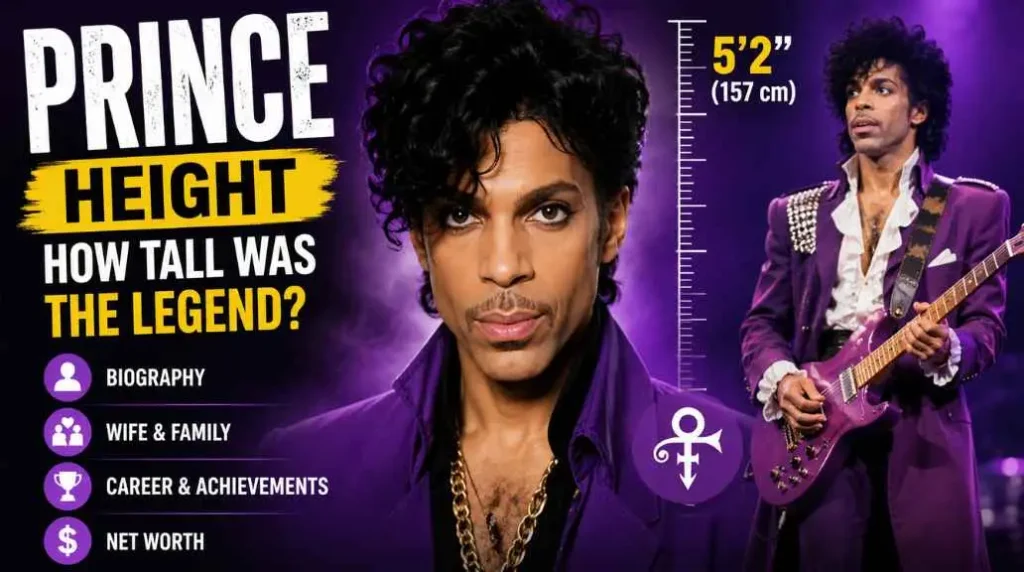
Fans searching for Prince height are often surprised by the answer. The legendary Minneapolis musician stood only around 5 feet 2 to 5 feet 3 inches (157–160 cm), depending on the source and measurement.
IMDb lists him at 5 feet 2 inches, while contemporary reporting and his autopsy-related records have commonly placed him around 5 feet 3 inches.
Yet height tells only a tiny part of Prince Rogers Nelson’s story. Onstage, his physical size seemed almost irrelevant. He could walk onto a massive arena stage in heeled boots, pick up a guitar, and command thousands of people with the confidence of someone twice his apparent size.
His voice could move from a delicate falsetto to a fierce rock scream, while his musicianship crossed funk, soul, R&B, pop, rock, jazz, and psychedelic sounds.
Born in Minneapolis in 1958, Prince became one of the most inventive and fiercely independent artists of the modern music era.
He wrote, produced, arranged, sang, danced, played multiple instruments, acted, directed, and built an enormous musical catalog. His breakthrough with 1999 and Purple Rain transformed him from an ambitious young musician into a global superstar.
This complete biography looks beyond the frequently searched number and explores Prince’s height, age, childhood, family, relationships, career timeline, albums, achievements, finances, physical appearance, and enduring legacy.
Who Was Prince?
Prince Rogers Nelson was an American singer, songwriter, musician, producer, actor, dancer, and filmmaker whose career stretched from the mid-1970s until his death in 2016.
He was not simply a performer who happened to write his own songs. Prince built music from the ground up. His debut album, For You, demonstrated an extraordinary level of control: at only 19, he wrote, produced, arranged, composed, and performed virtually every part of the record himself. The official Prince discography notes that he played all the vocals and instruments on the album.
His influence became especially visible during the 1980s. 1999 introduced his music to a much wider audience, while Purple Rain turned him into an international phenomenon. He later continued experimenting rather than simply repeating the formula that made him famous.
Prince also became famous for challenging conventional ideas about gender, sexuality, fashion, celebrity, and artistic ownership. His flamboyant clothing, high-heeled boots, makeup, lace, ruffles, and distinctive hairstyles became inseparable from his public image.
The Rock & Roll Hall of Fame describes his work as a genre-defying mixture of rock, funk, soul, pop, jazz, and other influences, emphasizing his ability to master multiple instruments and constantly reinvent his sound.
Prince Age
Prince was born on June 7, 1958, in Minneapolis, Minnesota.
He died on April 21, 2016, at the age of 57, at his Paisley Park estate in Chanhassen, Minnesota.
If Prince were alive in 2026, he would be 68 years old.
His age at death is striking when placed beside the amount of music he created. He released dozens of albums during his lifetime and maintained an unusually high level of creative productivity for nearly four decades. The official Prince discography describes a catalog containing dozens of albums as well as hundreds of songs and a substantial body of unreleased recordings.
Prince Biography
| Field | Details |
|---|---|
| Full Name | Prince Rogers Nelson |
| Stage Name | Prince |
| Date of Birth | June 7, 1958 |
| Birthplace | Minneapolis, Minnesota, U.S. |
| Date of Death | April 21, 2016 |
| Age at Death | 57 |
| Nationality | American |
| Profession | Singer, songwriter, musician, producer, actor, filmmaker |
| Genres | Funk, R&B, pop, rock, soul, jazz, new wave |
| Known For | Purple Rain, 1999, “When Doves Cry,” “Kiss,” “Little Red Corvette” |
| Marital Status | Divorced at the time of his death |
| Children | One son, who died shortly after birth |
Early Life and Education

Prince grew up in Minneapolis in a musical household.
His father, John L. Nelson, was a pianist and songwriter, while his mother, Mattie Shaw, was a jazz singer. The two met through the Minneapolis music scene and married in 1957. Their musical backgrounds gave Prince an unusually close connection to performance from an early age.
That household did not remain intact. Prince’s parents separated when he was young, and the family situation became complicated. He and his sister, Tyka, spent time between their parents’ homes. Prince later lived with neighbors, the Anderson family, after leaving home.
Music became the place where he could exercise control.
He taught himself piano, guitar, and drums. Rather than treating music as a hobby, he became intensely absorbed in understanding how instruments worked together.
As a teenager, Prince formed the band Grand Central with André Anderson, later known as André Cymone, and Morris Day. The group eventually became known as Champagne. These early experiences gave Prince something important that formal education could not: real-world experience playing with other musicians and learning how a band functioned.
Prince attended Central High School in Minneapolis, where his interests extended beyond music. He was also athletic and played basketball. A contemporary Washington Post profile famously described him as approximately 5 feet 3 inches tall while noting his endurance and ball-handling ability.
His small physical frame became part of the mythology surrounding him. Prince himself understood that people sometimes underestimated him. In later reflections about his childhood, he discussed being teased and said that he eventually used a louder, flashier public persona as a form of compensation.
That transformation became one of the defining stories of his career: the young boy who could be underestimated became a performer who demanded attention the moment he entered a room.
Prince Height, Weight, and Physical Appearance
So, how tall was Prince?
The safest answer is approximately 5 feet 3 inches (160 cm), although some databases list him at 5 feet 2 inches or 5 feet 2½ inches. IMDb has listed both 5’2″ and 5’2½” in different versions of its biography data, while a contemporary Washington Post report gave his height as 5’3″, “give or take an inch.”
His postmortem records have also been reported as listing him at 5 feet 3 inches and 112 pounds. That figure should be understood as a measurement at the time of his death, not a fixed weight throughout his career.
Prince deliberately transformed his appearance into part of his artistic language. He frequently wore platform or heeled footwear, tailored suits, elaborate shirts, ruffled clothing, bright colors, jewelry, and theatrical stage outfits.
His clothing was not simply designed to make him appear taller. It helped construct a character.
He could look elegant one night, rebellious the next, and almost otherworldly after that. His physical presence became less about conventional masculinity and more about mystery, confidence, sensuality, and performance.
| Attribute | Details |
|---|---|
| Height | Approximately 5’3″ (160 cm); sources vary around 5’2″–5’3″ |
| Weight | Approximately 112 lb reported at death |
| Body Type | Petite/slender |
| Hair Color | Black/dark |
| Eye Color | Brown, commonly reported |
| Tattoos | No widely documented signature tattoos |
| Style | Glamorous, flamboyant, tailored, theatrical, often including heeled footwear |
The important point is that Prince never allowed his height to become the definition of his presence. If anything, he turned the contrast between his petite frame and enormous stage authority into part of his appeal.
Read more: Ace Love Island Height: Age, Bio, Girlfriend & Net Wort (2026)
Prince Career Journey: From Minneapolis Prodigy to Global Icon
Prince’s career is remarkable because he did not follow a conventional superstar trajectory. He was not interested in staying inside one musical category.
He repeatedly changed the rules.
1975–1977: The Young Musician Emerges
1975–1976 — Early professional development:
Prince began building connections within Minneapolis music circles while developing his songwriting and multi-instrumental skills.
1977 — Warner Bros. deal:
His manager Owen Husney helped him secure a groundbreaking recording agreement with Warner Bros. The deal gave the young musician unusual creative control and established the foundation for his professional career.
1978: For You
1978 — Debut album:
Prince released For You, arriving in the industry at only 19.
What made the project extraordinary was not merely his youth. The album credits showed an artist taking control of nearly every part of the recording process. Prince wrote, arranged, produced, composed, and performed the music.
The single “Soft and Wet” became his first Billboard Hot 100 entry.
It was not yet superstar success, but the album revealed something more important: Prince was not going to be easily controlled by a record company.
1979–1981: Building His Sound
1979 — Prince:
His second album expanded his commercial profile and included “I Wanna Be Your Lover,” which became a significant early hit.
1980 — Dirty Mind:
Prince began pushing harder against musical and social conventions. The album combined funk, rock, new wave, sexuality, and stripped-down production.
1981 — Controversy:
The music became even more provocative. Prince was developing a recognizable persona that could be playful, sensual, spiritual, political, and confrontational within the same artistic world.
1982: 1999 Changes Everything
1982 — 1999:
The double album became Prince’s breakthrough into mainstream American pop.
Songs such as “1999,” “Little Red Corvette,” and “Delirious” became major hits. The album was his first to enter the Billboard Top 10, eventually reaching No. 9.
This was the moment Prince stopped being merely a promising musician and became a serious cultural force.
1984: Purple Rain
1984 — Purple Rain:
Everything changed.
The album and accompanying film transformed Prince into a global superstar. Purple Rain became his first No. 1 album and generated some of the defining songs of the decade, including “When Doves Cry,” “Let’s Go Crazy,” and the title track.
The film was semi-autobiographical, allowing audiences to see a dramatized version of the Minneapolis music world that had shaped him.
Prince also won his first three Grammy Awards connected to the Purple Rain era. He later won an Academy Award for the film’s original song score.
1985–1988: Reinvention Becomes the Strategy
1985 — Around the World in a Day:
Rather than simply making another Purple Rain, Prince moved into psychedelic pop and more experimental territory.
1986 — Parade:
The album produced “Kiss,” one of his most recognizable songs.
1987 — Sign o’ the Times:
Prince released one of the most ambitious projects of his career. The album blended funk, rock, soul, electronic music, gospel, jazz influences, and socially conscious songwriting.
The Recording Academy later inducted Sign o’ the Times into the Grammy Hall of Fame.
1989: Batman
1989 — Batman soundtrack:
Prince responded to Tim Burton’s Batman with an album that generated another No. 1 Billboard Hot 100 single, “Batdance.”
1990–1992: New Directions
1990 — Graffiti Bridge:
Prince revisited the fictional world introduced in Purple Rain while continuing his work with The New Power Generation.
1991 — Diamonds and Pearls:
The album introduced audiences to the New Power Generation and produced “Cream,” another No. 1 single.
1993–1999: The Name Becomes a Statement
1993 — Name change:
Prince’s battle with Warner Bros. over creative control and ownership of his music became one of the defining business conflicts of his career.
He adopted the famous unpronounceable symbol that combined traditionally masculine and feminine forms. The press often called him “The Artist Formerly Known as Prince.”
The change was not a publicity gimmick alone. It was a public declaration of independence.
1995 — The Gold Experience:
Prince continued challenging the conventional relationship between artist and record company.
1996 — Emancipation:
The three-disc project became one of the largest musical statements of his post-Warner period.
1998–1999:
Prince continued releasing music at a pace that would have overwhelmed many artists. His creative output remained remarkably broad.
2000–2009: Independence and a New Generation
2000 — Prince returns to his name:
After his Warner Bros. contract ended, he began publicly using the name Prince again.
2004 — Rock & Roll Hall of Fame:
Prince was inducted into the Rock & Roll Hall of Fame, with OutKast and Alicia Keys participating in the induction. The Hall describes his impact as genre-defying and highlights his musicianship, innovation, and independence.
2004 — Musicology:
The album returned Prince to major commercial success and supported a highly successful tour.
2006 — 3121:
Prince continued demonstrating that he could still compete commercially while retaining his distinctive sound.
2007 — Super Bowl XLI:
His halftime performance became one of the most celebrated shows in Super Bowl history.
2010–2015: The Final Creative Chapter
2010 — 20Ten:
Prince continued working outside the conventional music-industry model.
2014 — Art Official Age and Plectrumelectrum:
He released two projects that demonstrated his continuing interest in contemporary production and collaboration.
2015 — HITnRUN Phase One and HITnRUN Phase Two:
The latter became the final studio album released during his lifetime. The official Prince discography identifies HITnRUN Phase Two as his final studio album, released in December 2015.
2016: Final Performances and Death
April 2016:
Prince died at Paisley Park at the age of 57.
His death shocked the music world because he had remained creatively active and had continued performing shortly before his passing.
The Recording Academy reported that he had earned seven Grammy Awards during his career and had produced five No. 1 Billboard Hot 100 singles: “When Doves Cry,” “Let’s Go Crazy,” “Kiss,” “Batdance,” and “Cream.”
2017–2026: The Legacy Continues
Prince’s death did not end his creative story.
His estate has continued to release archival recordings, deluxe editions, and previously unavailable material. The official discography emphasizes that hundreds of songs remain part of a vast body of work, including recordings that were never released during his lifetime.
2024 — Songwriters Hall of Fame:
Prince was formally inducted posthumously into the Songwriters Hall of Fame. The organization noted that he had originally been elected in 2013, but the formal induction was delayed because of its attendance policy and Prince’s schedule.
2025 — Grammy Lifetime Achievement recognition:
Prince was among the artists selected for the Recording Academy’s Lifetime Achievement Award, further cementing the breadth of his contribution to music.
2026 — Continuing influence:
Ten years after his death, Prince remains a reference point for musicians who value songwriting, musicianship, independence, performance, and creative control.
Prince Wife and Children
Prince was married twice.
His first wife was Mayte Garcia, a dancer and singer who became closely connected to his musical world. The two married on Valentine’s Day in 1996. Their marriage was marked by both creative partnership and profound personal tragedy.
The couple had a son, Amiir, born in October 1996. The baby died approximately one week after birth because of Pfeiffer syndrome, a rare genetic disorder. The loss profoundly affected the couple and their marriage. Prince and Garcia eventually divorced.
Prince married his second wife, Manuela Testolini, in 2001. Testolini had worked with one of Prince’s charitable organizations. Their marriage ended in divorce in 2006.
Prince had no surviving children at the time of his death.
His private nature meant that much of his personal life remained away from the public eye. Unlike many celebrities, he did not routinely turn relationships and family matters into publicity.
Prince Family Background
| Family Member | Relationship | Details |
|---|---|---|
| John L. Nelson | Father | Pianist and songwriter; performed under the stage name Prince Rogers |
| Mattie Shaw | Mother | Jazz singer and musician |
| Tyka Nelson | Sister | Musician and Prince’s sister |
| André Anderson | Early musical associate | Later known as André Cymone; worked with Prince during his teenage years |
| Mayte Garcia | First wife | Dancer and singer; married Prince in 1996 |
| Manuela Testolini | Second wife | Philanthropist; married Prince in 2001 |
| Amiir Nelson | Son | Died approximately one week after birth |
Prince’s relationship with his parents was complicated, but their musical influence was enormous. His father’s piano playing and his mother’s jazz background helped create the environment from which Prince’s extraordinary musicianship emerged.
Major Works, Albums, and Projects
Albums and Major Projects
For You (1978)
Prince’s debut was a declaration of independence. At 19, he handled virtually every musical role himself, showing the extraordinary control that would define his career.
Prince (1979)
This album expanded his reputation and included “I Wanna Be Your Lover,” an important early commercial breakthrough.
Dirty Mind (1980)
A leaner, more provocative project that pushed funk, rock, new wave, and sexuality into the same musical space.
1999 (1982)
The album that brought Prince into the mainstream. “1999” and “Little Red Corvette” became defining songs of the era.
Purple Rain (1984)
His signature project. The album and film established Prince as a global superstar and produced some of the most enduring songs in popular music.
Parade (1986)
Known especially for “Kiss,” it showed that Prince could strip his sound down while making it more powerful.
Sign o’ the Times (1987)
A sprawling and adventurous album often regarded as one of his most musically ambitious works.
Diamonds and Pearls (1991)
A major commercial project that introduced the New Power Generation to a wider audience.
Emancipation (1996)
A three-disc statement representing Prince’s post-Warner independence.
Musicology (2004)
A major later-career success that helped introduce Prince to a new generation.
3121 (2006)
A commercially successful late-career project with a strong funk and R&B identity.
HITnRUN Phase Two (2015)
Prince’s final studio album released during his lifetime.
Popular Songs
Among Prince’s most influential and recognizable songs are:
- “When Doves Cry”
- “Purple Rain”
- “1999”
- “Little Red Corvette”
- “Let’s Go Crazy”
- “Kiss”
- “Raspberry Beret”
- “Sign o’ the Times”
- “Cream”
- “Batdance”
- “I Wanna Be Your Lover”
- “Nothing Compares 2 U”
His songwriting influence also extended beyond his own recordings. Other performers found major success with songs Prince wrote, demonstrating that his talent was not limited to his own voice or persona.
Awards and Achievements
Prince’s award history reflects both commercial success and critical respect.
- 7 Grammy Awards from 38 nominations according to the current Recording Academy artist profile.
- Academy Award for Purple Rain‘s original song score.
- Golden Globe Award for “The Song of the Heart” from Happy Feet.
- Rock & Roll Hall of Fame induction in 2004.
- Songwriters Hall of Fame induction, formally celebrated posthumously in 2024.
- 1999 and Purple Rain were inducted into the Grammy Hall of Fame.
- Sign o’ the Times was later inducted into the Grammy Hall of Fame.
- He achieved five No. 1 Billboard Hot 100 singles.
- He sold at least 100 million records worldwide, according to widely cited career records.
The numbers matter, but they do not fully explain Prince’s importance. His bigger achievement was expanding the definition of what a recording artist could control.
Prince Social Media Presence
Prince died before social media became the dominant promotional tool it is today, so his current accounts are primarily managed as official legacy channels rather than personal profiles.
| Platform | Official Presence |
|---|---|
| @prince | |
| @prince | |
| X | @prince |
| YouTube | Prince official channel |
| TikTok | @prince |
| Snapchat | @prince |
| Official Website | Prince official digital properties |
The official Prince Linktree currently connects fans with Instagram, Facebook, TikTok, YouTube, Snapchat, and X, along with the official website and store.
These channels focus on preserving Prince’s music, promoting archival releases, celebrating his legacy, and directing fans toward official projects.
Prince Net Worth
Prince’s finances are unusually complicated because his wealth cannot be reduced to a simple celebrity “net worth” estimate.
At the time of his death, his estate included music publishing rights, recordings, real estate, business interests, his name and likeness, and other assets. The value of those assets became the center of a lengthy legal dispute.
Initially, Comerica Bank & Trust, the estate administrator, valued the estate at approximately $82.3 million. The IRS later argued that the estate was worth approximately $163.2 million. In 2022, the two sides reached a settlement that placed the estate’s agreed value at $156.4 million.
That $156.4 million figure is the most defensible documented number to use when discussing the value of Prince’s estate. It should not automatically be presented as a modern personal net-worth figure, because estate valuation, taxes, legal expenses, later catalog transactions, and posthumous earnings are different financial concepts.
Where Prince’s Wealth Came From
Music sales and streaming:
Prince released an enormous catalog that continues to generate revenue.
Songwriting and publishing:
His songwriting rights were among his most valuable assets because songs can generate income for decades through recordings, licensing, performances, and synchronization.
Recordings:
Prince controlled or held interests connected to a substantial body of recorded music.
Concerts and touring:
Live performances were another major source of income during his lifetime.
Film and entertainment:
Projects such as Purple Rain expanded his earnings beyond recorded music.
Real estate:
Paisley Park and other property interests were part of his estate.
Name, likeness, and intellectual property:
Prince’s distinctive identity itself became a valuable commercial asset after his death.
The estate’s valuation dispute illustrates why celebrity net-worth figures found online can be misleading. The difference between $82.3 million and $163.2 million was not simply a disagreement over cash in a bank account. Much of the argument centered on how to value intangible assets, especially Prince’s music interests.
Interesting Facts About Prince
- Prince was an extraordinary multi-instrumentalist.
His debut album demonstrated that he could handle an astonishing number of musical roles himself. - His height became part of his mythology.
Prince was approximately 5’2″–5’3″, yet he developed one of the most commanding stage presences in popular music. - He was a high school basketball player.
Despite his small frame, contemporary reporting noted his endurance and ball-handling skills. - He changed his name to a symbol.
The decision came during his conflict with Warner Bros. and became one of the most memorable acts of artistic protest in modern music history. - He created music at an extraordinary pace.
His official catalog contains dozens of albums, while hundreds of additional songs and unreleased recordings remain part of the larger Prince vault. - He continued creating until the end of his life.
HITnRUN Phase Two, released in December 2015, was the final studio album issued during his lifetime, only months before his death.
FAQs
1. What was Prince height?
Prince height was approximately 5 feet 3 inches (160 cm). Some sources list him closer to 5 feet 2 inches or 5 feet 2½ inches, so approximately 5’2″–5’3″ is the most responsible range.
2. How old was Prince when he died?
Prince was 57 years old when he died on April 21, 2016. He was born June 7, 1958.
3. How tall was Prince compared with other male celebrities?
Prince was notably shorter than the average adult American man. He was generally reported around 5’2″–5’3″. However, his stage footwear, posture, costumes, and commanding performance style could make him appear considerably taller.
4. Who was Prince’s wife?
Prince was married twice. His first wife was Mayte Garcia, whom he married in 1996. His second wife was Manuela Testolini, whom he married in 2001. Both marriages ended in divorce.
5. Did Prince have children?
Yes. Prince and Mayte Garcia had a son who died approximately one week after birth because of Pfeiffer syndrome. Prince did not have surviving children at the time of his death.
6. What was Prince’s net worth?
There is no single reliable modern “net worth” figure for Prince. His estate was ultimately valued at $156.4 million in an agreement involving the estate administrator, the IRS, and the heirs. That valuation included music rights, real estate, and other assets.
7. What was Prince’s most famous album?
Purple Rain is generally considered Prince’s signature album. Released in 1984 alongside the film of the same name, it produced several of his best-known songs and helped establish him as a global superstar.
8. How many Grammy Awards did Prince win?
Prince won seven Grammy Awards during his career. The Recording Academy currently lists him with 38 nominations.
9. What made Prince so influential?
Prince combined exceptional musicianship with songwriting, production, performance, visual identity, and business independence. He crossed genres rather than remaining inside one category and influenced generations of artists.
Conclusion
The question of Prince height begins with a simple measurement: roughly 5 feet 3 inches. But that number becomes almost ironic when placed beside the scale of his career.
Prince Rogers Nelson may have had a petite physical frame, but he occupied enormous space in popular culture.
He was a songwriter who could create intimate ballads and explosive funk records. He was a guitarist capable of turning a solo into a theatrical event. He was a producer who understood how to build an entire sonic world. He was a performer who treated clothing, movement, lighting, sexuality, mystery, and musicianship as parts of the same artistic language.
His journey from a Minneapolis teenager to an international icon was not built on height, conventional looks, or a willingness to follow industry expectations. It was built on ability and an almost relentless desire to control his own creative direction.
The statistics are impressive: seven Grammys, an Academy Award, Rock & Roll Hall of Fame recognition, a vast catalog, millions of records sold, and songs that remain embedded in popular culture.
But Prince’s deepest legacy may be the freedom he represented.
He showed that an artist could be strange without apologizing, glamorous without being predictable, masculine without fitting traditional expectations, and commercially successful without surrendering every piece of creative control.
So while fans may continue searching for Prince height, the more meaningful measurement is impossible to calculate. His physical height was around 5’2″–5’3″. His artistic reach was immeasurably larger.

Nathaniel Gray is a thoughtful content creator specializing in inspirational and faith-based writing. His work emphasizes clarity, wisdom, and emotional strength through simple yet powerful messages.


